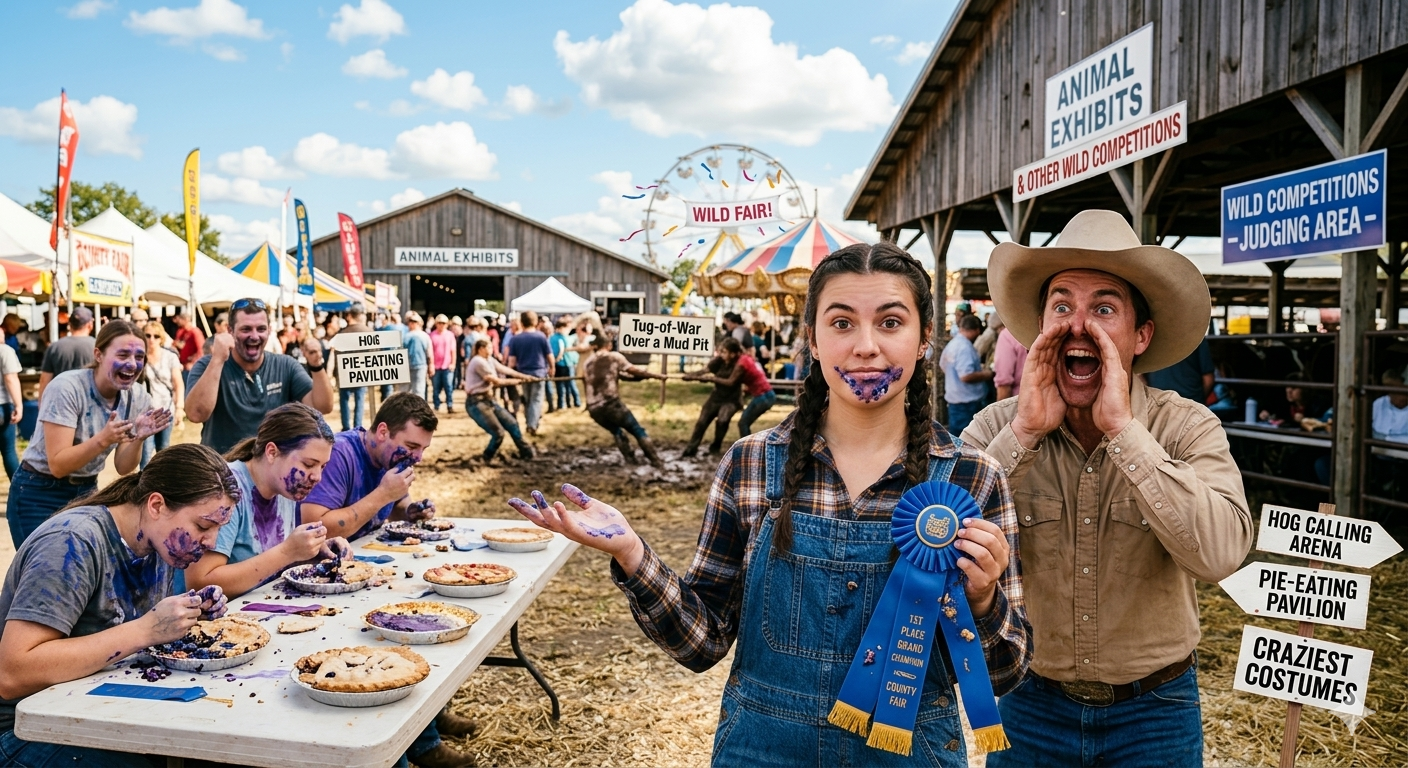
Most people think of county fairs as a place for livestock shows, carnival rides, and funnel cake. And they are right. But tucked between the exhibit halls and the midway, something far more entertaining tends to be happening. Pie-eating contests where hands are not allowed.
Wildest Fair Competitions: Pie-Eating, Hog Calling & More
Hog calling competitions where adults stand on a stage and scream at the top of their lungs. Frog jumping events with a $20,000 prize still sitting unclaimed. These are not fringe events. They are some of the most beloved traditions in American fair culture, and at CountyFairsUSA.net, we have been covering county and state fairs, contests, and competitions across America since 1999. If you want to understand what makes a county fair genuinely fun, start here.
The Classic Contests That Started It All
Long before competitive eating became a televised sport with sponsorship deals, county fairs were running their own version of it every summer. Pie-eating contests, watermelon seed spitting, and hog calling did not start as entertainment. They grew out of real agricultural and rural life, and somewhere along the way they became the highlight of the fair schedule.
Hog calling is a perfect example. On a working farm, being able to call your hogs in from the field was a legitimate daily skill. Fairs turned it into a contest, added an audience and a judging panel, and suddenly you had grown adults competing for a blue ribbon by hollering across the fairgrounds as loud and dramatically as possible. The crowds loved it, and they still do.
These old-school contests stuck around because they tap into something genuine. They do not require expensive equipment, years of training, or a pedigreed animal. Anyone can walk up to a pie and give it their best effort, and that accessibility is a big part of why these competitions fill the grandstands every single year.
Eating Contests: The Crowd Always Shows Up
Of all the wild competitions at a county fair, eating contests draw the biggest crowds and the loudest reactions. They are participatory, unpredictable, and almost always messy, which is a combination that is very hard to beat.
The most traditional version requires no hands. Competitors press their face directly into the pie, watermelon, or corn dog on the table in front of them, and the person who finishes first wins. The crowd tends to enjoy this more than the competitors do, especially by the midpoint of the contest.
Common eating competitions found at county and state fairs across America:
- Pie-eating contests, the hands-free classic that has been running at American fairs for generations
- Hot dog eating contests that draw serious local competitors and plenty of first-timers
- Watermelon eating races judged by speed and general chaos
- Corn on the cob speed eating, where technique matters as much as appetite
- Jalapeno eating challenges for those who want to suffer publicly and competitively
- Funnel cake and fair food specialty eating challenges at some larger state fairs
CountyFairsUSA.net covers hot dog eating contests, pie contests, and food competitions throughout our Contests category, with event listings across dozens of states during fair season.
Hog Calling and Animal Voice Competitions
If you have never watched a hog calling contest, you are missing one of the most entertaining ten minutes a county fair can offer. Competitors walk up to a microphone, or sometimes just to the edge of a stage, and produce the loudest and most convincing call they can manage in front of a crowd that is absolutely ready to react.
What makes it so watchable is the complete absence of a standard technique. Some competitors go loud and operatic. Some go full country holler. Some invent something new on the spot. A few have been known to break into song. The audience gets to respond however they see fit, and they are rarely quiet about it.
Hog calling is part of a broader family of animal voice competitions that appear across the county fair calendar:
- Rooster crowing contests where the bird with the longest sustained crow takes home the ribbon
- Husband calling and Mom calling competitions where participants summon a spouse or parent from across the fairgrounds in the most dramatic fashion possible
- Duck and turkey calling events common at rural fairs across the South and Midwest
- Cow calling contests at agricultural fairs with deep farming roots
These competitions fall under what many fair programs call Rural Americana or Heritage Contests, and they exist specifically to keep traditions alive that would otherwise disappear as farming becomes less central to everyday American life. CountyFairsUSA.net covers livestock, animals, and fair entertainment across all categories, and these events are consistently among the most attended on the schedule.
Mutton Bustin: The Kids Take the Spotlight
No list of wild fair competitions is complete without mentioning mutton bustin, and if you have seen it in person you already know why. Children between the ages of five and seven are placed on the back of a sheep and asked to hold on for as long as possible. What follows is approximately four seconds of determination followed by a spectacular tumble into the dirt, and the crowd goes absolutely wild for every single attempt.
Mutton bustin is a fixture at county fairs and rodeo events across the country and is covered extensively on CountyFairsUSA.net through our Rodeo and Livestock categories. It is one of those events that parents come to see for their kids and then end up watching for an hour because they cannot stop laughing.
Kids who manage to stay on longest are judged on style, grip, and duration, and the winners tend to walk away with a level of fairground fame that far exceeds what the blue ribbon is actually worth.
The Truly Odd: Frogs, Lawnmowers, and Cow Chips
Some fair contests go well beyond eating and shouting. These events have entire histories behind them, passionate regular competitors, and in at least one case, a world record that has stood unchallenged since 1986.
The frog jumping contest at the Calaveras County Fair in Angels Camp, California, is arguably the most famous unusual contest in American fair history. The event started in 1928 and was inspired by Mark Twain’s short story about a jumping frog from the Gold Rush era. The world record stands at just over 21 feet set by a frog named Rosie the Ribeter, and the cash prize for breaking it is $20,000. Nobody has claimed it in nearly four decades. Professional frog teams now travel from across the country and internationally to compete, and the contest runs all four days of the fair with thousands of entrants.
Other genuinely odd fair competitions worth seeking out include:
- Watermelon seed spitting, judged on distance with no hands allowed and usually a very confused front row
- Cow chip throwing, a Midwest fair staple where dried material is launched for maximum distance
- Lawnmower racing on modified riding mowers with the blades removed, timed across a dirt course
- Greased pig catching, usually run as a kids event featuring a very slippery piglet and a lot of falling
- Corn shucking speed contests where efficiency and technique both matter
- Ugly cake contests judged on creative awfulness rather than baking quality
- Outhouse races where wheeled portable outhouses are pushed or raced down a track
Why These Contests Matter More Than They Look
It is easy to dismiss these events as silly, and that is entirely the point. But there is something more happening than just laughs. These competitions do something that the livestock show and the quilt exhibit cannot always accomplish: they get complete strangers laughing at the same moment, standing shoulder to shoulder, sharing something spontaneous and real.
You do not need a prized heifer or a blue-ribbon pie recipe to enter a hog calling contest or a watermelon seed spitting competition. The barrier to entry is almost nothing, which means these events pull in people who would never normally compete at a fair. That kind of open participation is exactly what county fairs are supposed to be about.
At CountyFairsUSA.net and CountyFairgrounds.net, we have covered these contests and the fairs that run them for over 25 years. These competitions draw real crowds, create real memories, and are one of the best arguments for actually attending a county fair rather than just reading about one.
How to Find Fairs With the Best Contest Lineups
Not every county fair runs the same contest schedule, and the best ones plan their competition programs well in advance. A few ways to find events worth showing up for:
- Check the fair’s official website or premium book for a full contest schedule before you go
- Look for fairs that advertise their specialty competitions and heritage events specifically
- Larger county and state fairs tend to run the most varied contest programs with the most participant turnout
- Use CountyFairsUSA.net and CountyFairgrounds.net to browse upcoming fairs by state and find events near you
County fairs have always known how to make people laugh, compete, and come back next year. The pie-eating contests, the hog calling stages, and the frog jumping arenas are a big part of why that tradition has lasted well over a century, and they show absolutely no sign of slowing down.