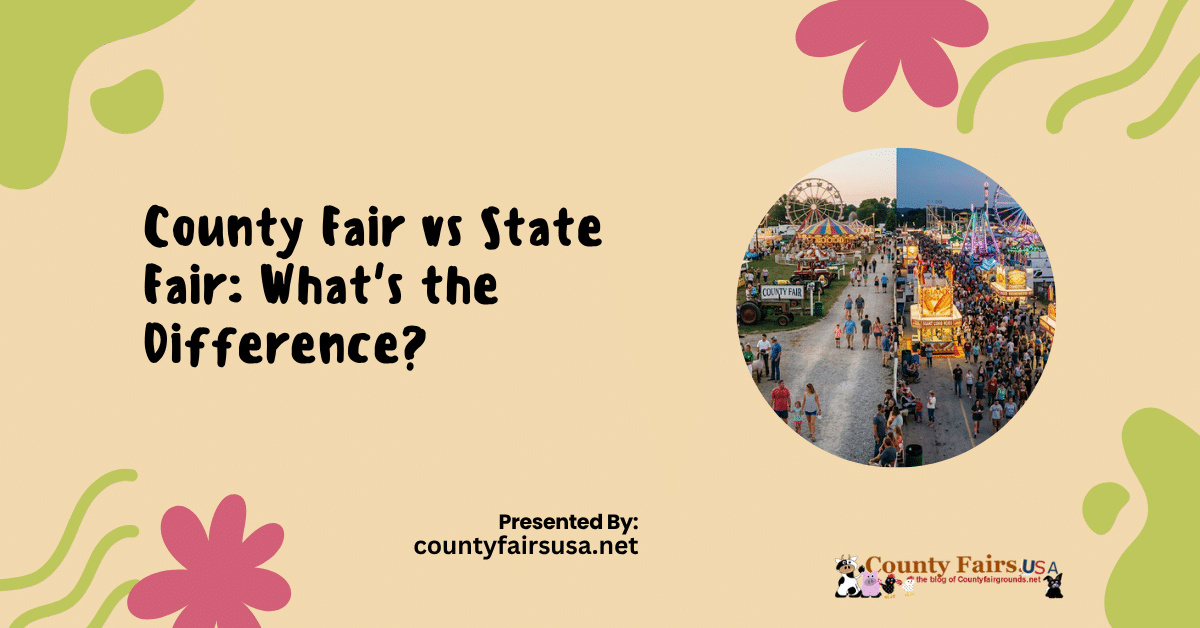
A county fair is run by a single county and usually lasts three to seven days, while a state fair represents an entire state, runs one to three weeks, and pulls in the winners who already proved themselves at the county level. Think of it as a playoff system: the county fair is the regional bracket, and the state fair is the championship.
Both share the same DNA of livestock, midway rides, and fried food on a stick. The scale, the stakes, and the atmosphere are completely different once you walk through the gate.
What Is a County Fair?
A county fair is organized by a county fair board or a local agricultural society, and it exists to celebrate one county’s farms, families, and youth programs.
Most county fairs run in the heart of summer, usually between mid-June and late August, and wrap up in under a week. The 2025 IAFE economic impact study found roughly 1,400 U.S. fairs averaging just under seven days each, which is the county fair rhythm in a nutshell.
What you will typically find:
- 4-H and FFA livestock shows, showmanship classes, and market animal auctions
- Home arts and open class entries: canned goods, quilts, baked pies, garden produce
- One midway operated by a regional carnival company
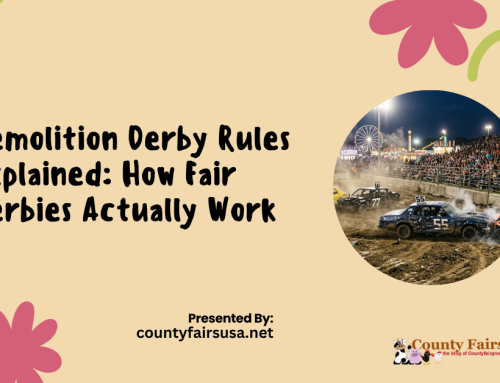
- Demolition derbies, tractor pulls, and truck and tractor events
- Local bands, church food booths, and volunteer-run gates
Admission is usually modest, often falling between $5 and $15, and plenty of small county fairs still charge nothing at the gate. The crowd is people you know. That is the entire point.
If you want a taste of that atmosphere at home, our guide on how to throw your own backyard county fair breaks it down.
What Is a State Fair?
A state fair is a single annual event representing the whole state, usually managed by a state agricultural society or a state-chartered fair authority.
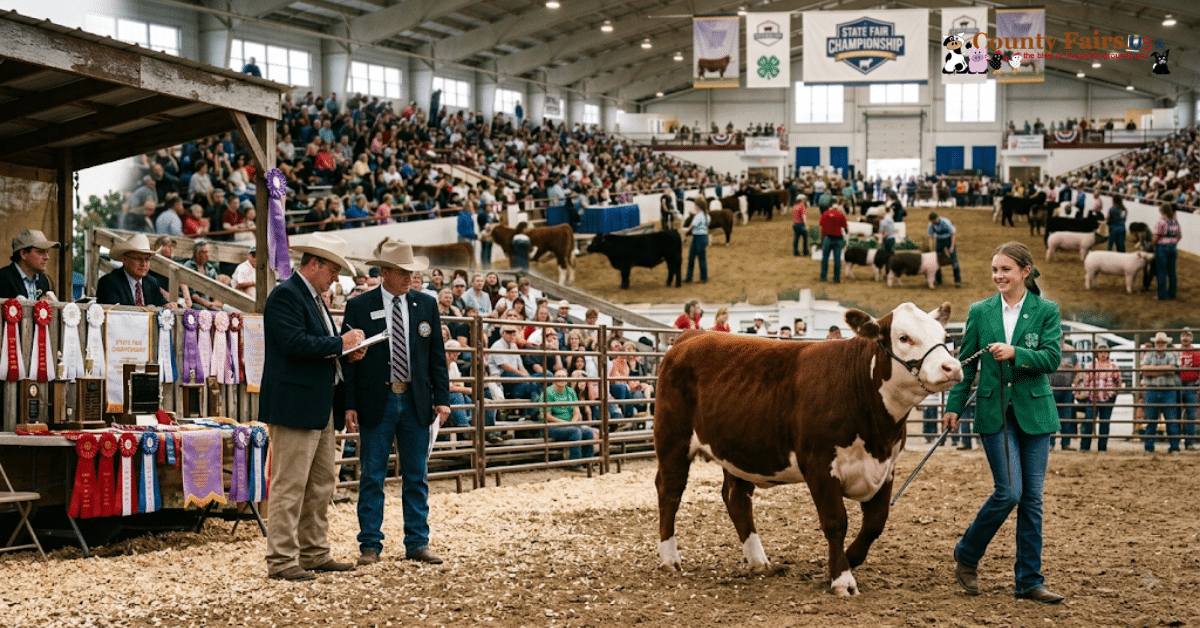
State fairs run far longer and sit on permanent, purpose-built fairgrounds that host events year round. The State Fair of Texas marked its 139th year in 2025 with more than 2.02 million guests across a 24-day run at Fair Park in Dallas. The Minnesota State Fair packed 1,940,869 people into just 12 days, which gives it the highest daily turnout of any American fair.
What sets a state fair apart:
- Statewide championship competition, often with money and scholarships attached
- Grandstand concerts featuring national touring artists
- Multiple midways and thrill rides that no county fair could host
- Large commercial and vendor halls, plus state agency exhibits
- Butter sculptures, giant pumpkins, and other signature traditions
One thing that surprises people: not every state has one. Connecticut, Maine, New Hampshire, and Rhode Island have no official state fair, and New England is largely served by the Big E in West Springfield, Massachusetts, which draws about 1.6 million visitors on behalf of all six New England states.
County Fair vs State Fair: Side by Side
| Factor | County Fair | State Fair |
| Scope | One county | Entire state |
| Typical length | 3 to 7 days | 10 to 24 days |
| Attendance | A few thousand to 150,000 | 500,000 to 2.3 million |
| Gate admission | Free to $15 | Mostly $15 to $25 |
| Competition level | Local qualifier | State championship |
| Entertainment | Local and regional acts | National headliners |
| Fairgrounds | Seasonal, often modest | Permanent, hundreds of acres |
| Season | June through August | August through October |
| Who runs it | County fair board, mostly volunteers | State authority with paid staff |
Iowa runs the largest fairground site in the top ten at 445 acres and draws roughly 1.18 million people. The Great New York State Fair, first held in Syracuse in 1841, is the oldest in the country and still charges only $6 at the gate.
How the Competition Pipeline Actually Works
This is the part most articles skip, and it is the real difference between the two.
At the county fair, a 4-H or FFA member shows an animal or enters a home arts project and is judged against other kids from that county. A purple or blue ribbon in many states is what earns the right to enter the state fair. In others, the county fair champion advances automatically in that class.
How the ladder generally runs:
- County level: open to residents of that county, judged locally, ribbons awarded by class
- District or regional level: used in larger states to thin the field before state
- State level: county champions compete for the state title, premium money, and scholarships
Not every entry moves up. Many county fairs keep an open class where anyone can enter for the fun of it, no advancement involved. That is where the neighbor’s zucchini bread and the retired farmer’s tomatoes end up, and it is often the most charming building on the grounds.
For families, this ladder is why the county fair carries weight. A season of feeding, walking, and grooming an animal comes down to one afternoon in the ring. Our post on 4-H and FFA at county fairs covers what those programs mean for young farmers.
Food, Rides, and Entertainment: Where the Gap Shows
At a county fair, the food stands are often run by the Lions Club, the volunteer fire department, or a church group raising money for the year. The pork chop sandwich comes from someone’s family recipe, and the line moves fast.

State fairs turn food into a competition of its own. Deep-fried novelty items get announced months in advance, vendors compete for “best new food” awards, and some concession stands have been in the same family for three generations.
The entertainment split:
- County fair: demolition derby, tractor pull, local cover band, rodeo, one carnival midway
- State fair: grandstand concerts with chart-topping artists, motorsports events, multiple midways, ticketed shows
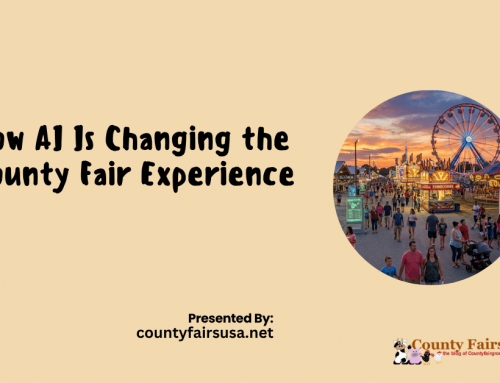
Rides follow the same pattern. County fairs get a regional carnival with the classics. State fairs bring the tallest rides in the state, and some install permanent attractions that stay year round. Our roundup of fair spectacles, fireworks, and light shows covers the big-ticket end of that.
Which One Should You Visit?
Both, honestly. But if you have to pick one this season, here is the practical breakdown.
Go to the county fair if:
- You have young kids and want a manageable, low-stress day
- Your budget is tight and parking headaches are a dealbreaker
- You want to actually talk to the people showing the animals
- You care about seeing agriculture up close instead of from a distance
Go to the state fair if:
- You want a concert, a thrill ride, or a food you cannot get anywhere else
- You are visiting the state and want one event that captures it
- You can handle crowds and want a full-day or multi-day outing
- You want to see the best livestock and craftsmanship in the state in one place
A family of four can usually do a county fair for the price of parking plus a few gate tickets at a state fair. Budget realistically for a state fair: admission, parking, ride wristbands, and food add up quickly.
Common Myths, Cleared Up
“A state fair is just a bigger county fair.” Not quite. The competition structure is different, the funding model is different, and state fairs run permanent year-round facilities that host expos, concerts, and horse shows outside fair season.
“County fairs do not have real rides.” Most contract with the same carnival companies that supply larger events. The lineup is smaller, not lesser, and the lines are far shorter.
“Only farm kids can compete.” Open class categories at nearly every county fair accept entries from anyone in the county. Photography, baking, needlework, and garden produce are all fair game.
“Fairs are dying out.” The IAFE study found 97.9 million people attended a U.S. fair in 2024, close to 29 percent of the population, generating $30 billion in economic activity. That is more than combined MLB and NFL attendance.
Planning Your Next Fair Season
The short version: county fairs are local, quick, affordable, and built around the people who live there. State fairs are longer, bigger, more expensive, and built around showcasing the best of an entire state.
Hit your county fair in July, then take the winners’ road trip to the state fair in late summer. You will see the same animals in a bigger ring, and you will understand exactly how much work it took to get there.
Browse our fair listings and blog to find dates near you.