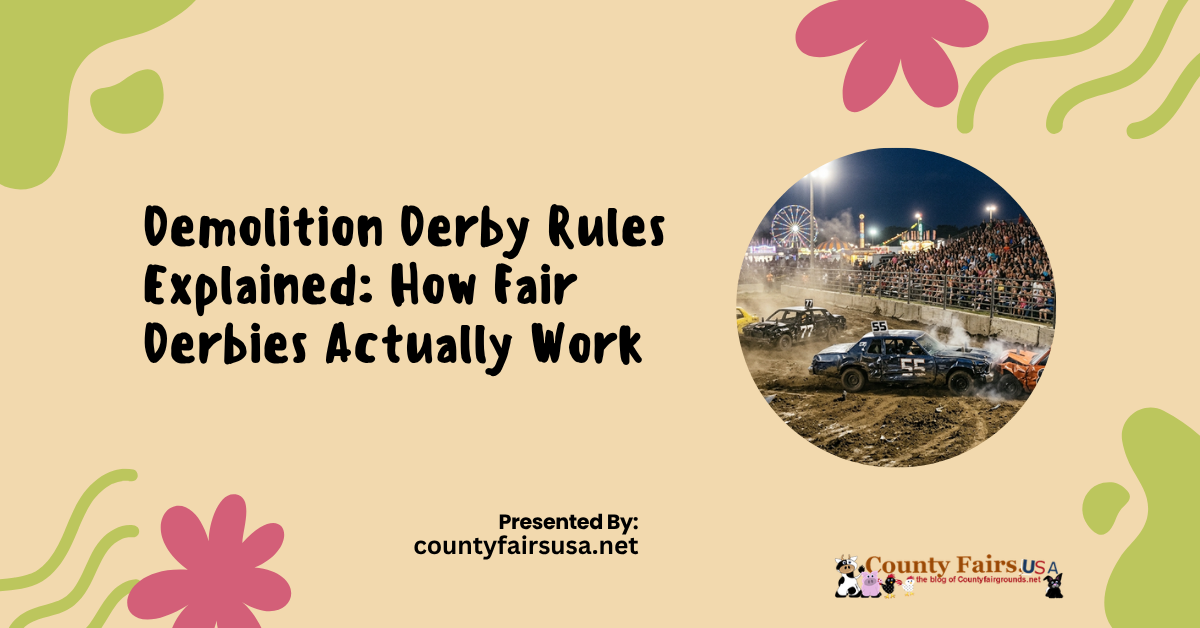
A demolition derby looks like pure chaos from the grandstand, but it runs on a written rulebook. Drivers ram each other in a dirt arena until one car is still moving under its own power, and that driver wins the heat. Every fair writes its own version, yet the safety and fairness rules stay remarkably consistent across the country.
Here is how the rules actually work, from the welding shop to the checkered flag.
What a Demolition Derby Is at a County Fair
The demolition derby traces back to the 1940s stock car scene and became a grandstand staple at American fairs through the 1960s. Today it sits alongside the rodeo and the tractor pull as one of the few events that fills bleachers on a weeknight.
A typical fair derby runs in three stages. Cars are split into heats of eight to twelve, heat winners advance, drivers knocked out early get one shot at a consolation round, and the survivors meet in the feature event for the top payout.
The Core Rules Every Derby Runs On
Strip away the local variations and the same handful of rules appear at almost every fairground in the country. If you learn these five, you can follow any derby in America.
- Last car moving wins. A car is out when it cannot move under its own power after being counted down by an official.
- Aggression rule. Most fairs give drivers 60 seconds to make solid contact. Sit and wait too long and you get a flag, then a disqualification.
- No driver door hits. Intentionally striking the driver’s side door is the fastest way to be pulled from an event, and many fairs ban the driver for the season.
- Fire, fuel, or smoke ends your night. Officials black flag any car leaking fuel, smoking heavily, or showing flame, no argument.
- Rollovers are usually over. Some fairs allow a car to be righted, but most treat a rollover as an automatic exit for safety reasons.
The aggression rule is the one casual spectators miss. Derby drivers are not just trying to wreck cars, they are trying to stay mobile while the 60-second clock keeps forcing them back into contact.
Car Preparation Rules
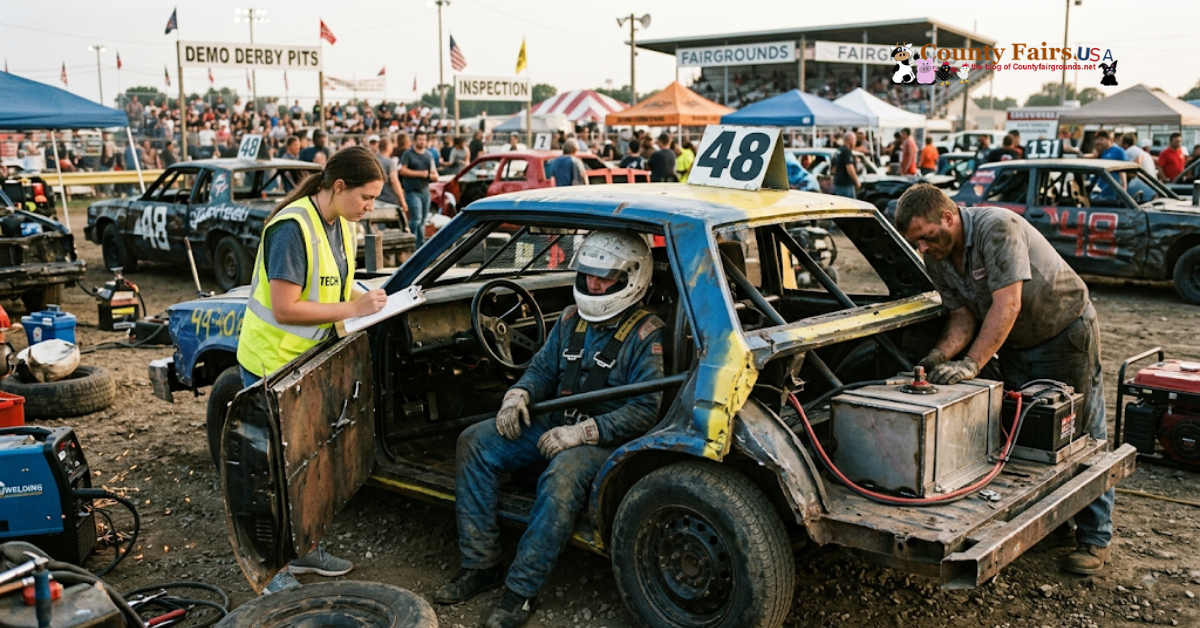
Tech inspection happens before a single engine fires, and this is where most drivers get sent home. The rules exist to keep a car from becoming a fire hazard or a weapon.
What Must Come Out
Every derby requires a full teardown before the car is legal. Officials walk the pits with a checklist and reject cars that skipped steps.
- All glass, including headlights, mirrors, and windshields
- Airbags, deployed or intact
- Interior trim, carpet, headliner, and all plastic
- Factory fuel tank, which must be removed from behind the rear axle
- Antifreeze, replaced with plain water so spills are not toxic on the dirt
What Must Go In
Removal is only half the job. The car then has to be rebuilt with safety equipment that meets the fair’s spec sheet.
- An approved fuel cell or marine tank, mounted behind the driver’s seat and strapped down
- A sealed battery box, relocated to the passenger floor
- A four-point harness or a factory belt in beginner classes
- A halo bar or roll bar behind the driver, plus a door bar on the driver’s side
- Doors chained or welded shut, with the driver door marked in contrasting paint
Where Reinforcement Stops
This is the rule that causes the most arguments in the pits. Fairs limit welding and frame work so that nobody shows up with a car built like a battering ram.
Most rulebooks allow a set number of welds per door seam, a specified plate thickness, and nothing else. Hidden frame stuffing, seam welding the full chassis, or adding a homemade bumper beyond the allowed dimensions gets a car parked before it ever reaches the arena.
Safety Gear and Driver Requirements
Driver rules are shorter than car rules but enforced just as hard. A driver who shows up without approved gear does not run, regardless of how good the car looks.
Most fairs require a DOT or Snell rated helmet, eye protection, long sleeves or a fire suit, and closed leather footwear. Minimum age is commonly 16 with a signed parent waiver, or 18 to run without one, and every driver must attend the pre-event meeting where officials review flag signals and that night’s specific calls.
Derby Classes and Why They Exist
Classes are the fairness backbone of the whole sport. Without them, a 1975 full frame sedan would simply drive through a compact car, and nobody would enter anything else.
| Class | Typical Cars | Key Rules | Skill Level |
| Full Size | Pre-1980 body-on-frame sedans and wagons | Heaviest builds, most welding allowed | Experienced |
| Compact | Four cylinder unibody cars under 108 inch wheelbase | Minimal reinforcement, stock bumpers common | Beginner friendly |
| Mini Van / Truck | Minivans, small pickups | Separate arena, higher rollover restrictions | Intermediate |
| Powder Puff | Same cars as men’s heats, often shared | Women drivers only, same tech rules | Mixed |
| Youth | Compacts, speed limited | Lower speeds, extra safety gear, tighter contact rules | Entry level |
Sharing a car between classes is common at smaller fairs. One family will run the same compact in the youth heat, the powder puff heat, and the feature on the same night, which is part of why derby remains an affordable fair event.
How Officials Keep the Event Fair
Fairness in a demolition derby is mostly enforced before the green flag drops. Tech inspectors measure bumpers, check weld counts, look inside frame rails with a light, and weigh cars in classes that carry a weight limit.
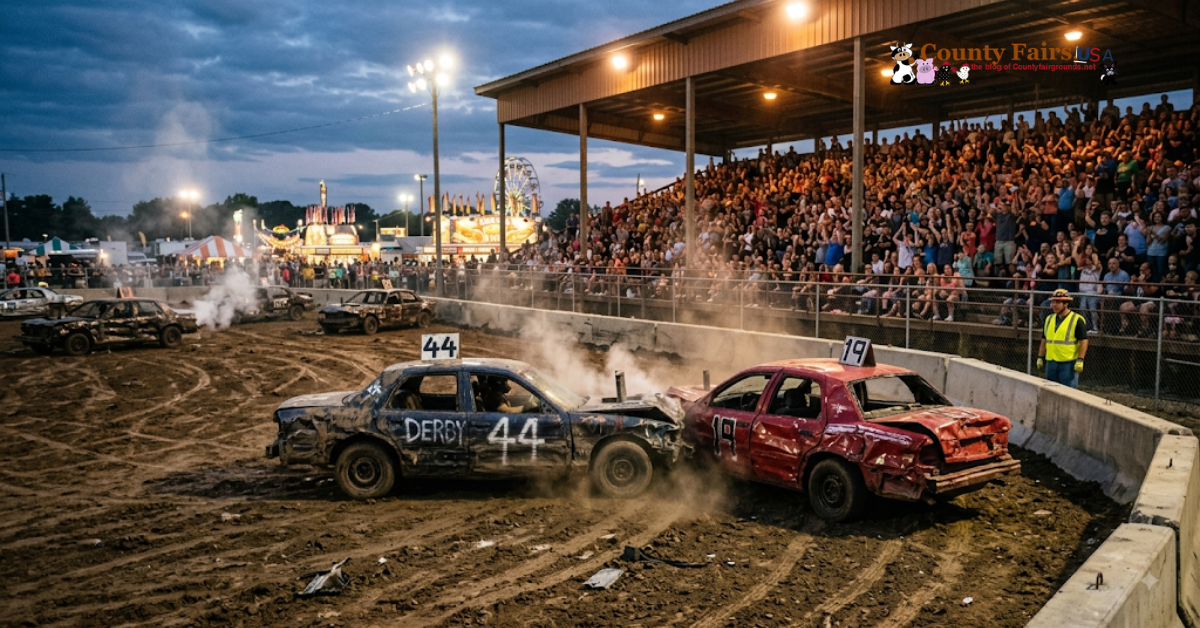
During the heat, officials watch for two specific violations that ruin the event for everyone else.
- Sandbagging. Hiding in a corner and letting others destroy each other. The 60-second clock and a warning flag handle this.
- Holding. Locking bumpers on purpose to pin another car and let a teammate hit it. Most fairs call this immediately.
- Team driving. Two or more drivers protecting each other instead of competing. Both get parked.
- Post-event teardown. Feature winners at larger fairs can be torn down and inspected. An illegal weld found after the win forfeits the prize money.
The protest process is worth knowing if you ever enter. A driver can usually protest a competitor’s car by posting a cash bond, and the loser of the protest forfeits it, which keeps frivolous complaints down.
How the Winner Is Decided
The winner is the last car capable of moving, but the path to that moment has structure. Heat winners advance to the feature directly, while drivers eliminated in the heats get one attempt in the consolation round for the final feature spots.
When two cars are both disabled at the same time, officials fall back on judgment. The car showing the last legitimate forward or reverse movement takes it, and at most county fairs the head official’s call is final with no appeal.
What to Watch for From the Grandstand
Once you know the rules, a derby stops looking random. Watching the strategy is what turns a first-time spectator into a regular.
- Cars hit in reverse. Drivers protect the radiator and engine by using the rear of the car as the weapon. A car doing lots of forward hits is usually new or desperate.
- Steam is the beginning of the end. A punctured radiator means a few minutes of life left, and everyone in the arena knows it.
- Watch the wheels, not the body. A crumpled car with straight wheels will outlast a clean car with a bent axle every time.
- Flag colors matter. Yellow stops action, black targets one car, and red ends the heat entirely.
Why the Rulebook Is What Makes the Chaos Work
The appeal of a demolition derby is that it looks lawless, and the reality is the opposite. Every rule about fuel cells, door hits, weld counts, and the 60-second clock exists because somebody got hurt or somebody cheated, and the sport wrote it down afterward.
That is also why derby has stayed a fair tradition for more than 60 years while other grandstand acts came and went. At Countyfairgrounds USA we track fair schedules across the country, so check your state’s fair listings to find the derby nights near you and get there early enough to walk the pits.
Frequently Asked Questions
Are demolition derbies dangerous for drivers? Serious injuries are rare because of mandatory harnesses, halo bars, fuel cell rules, and the ban on driver door hits. Bruising and soreness are common, but the modern rulebook has made derby far safer than its early decades.
Can you use any car in a demolition derby? No. Cars must fit a specific class, pass tech inspection, and follow strict preparation rules. Convertibles, four wheel drive vehicles, and hearses are banned at most fairs, and imported unibody cars are usually restricted to compact heats.
How much does it cost to build a derby car? A first compact build commonly runs between $500 and $1,500 including the car, safety gear, and welding supplies. Competitive full size builds at large fairs can run several thousand dollars once fuel cells, cages, and prep labor are counted.
Do demolition derby winners get paid? Yes. County fair feature purses typically range from a few hundred dollars to several thousand, plus smaller payouts for heat wins, consolation finishes, and the crowd-voted best appearing car award.
Is hitting the driver door allowed? Never intentionally. Deliberate driver door contact brings immediate disqualification at every sanctioned fair derby, and many events add a season-long ban for repeat offenders.