Goats

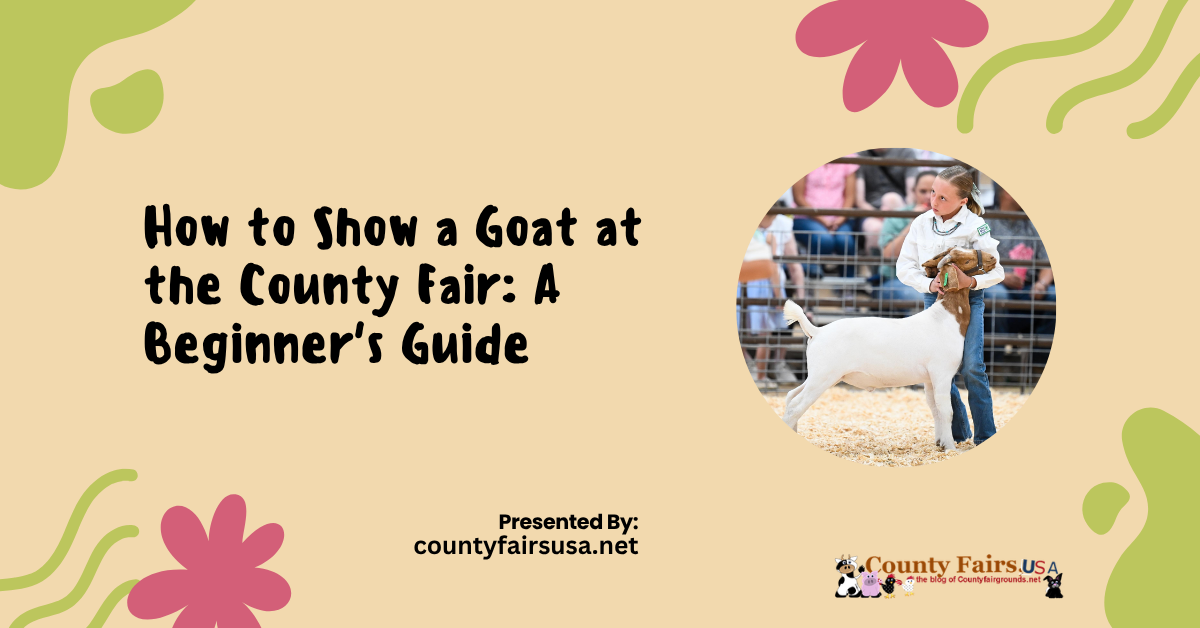
How to Show a Goat at the County Fair: A Beginner’s Guide

Showing a goat at the county fair is one of the best first livestock projects for young people. Goats are smaller than cattle, easier to handle than pigs, and full of personality. With a few months of steady work, a beginner can walk into the show ring with confidence. If you are new to livestock showing in general, our post on tips for winning a county fair livestock show is a helpful starting point. This guide explains how to show a goat step by step, from choosing your animal and training it to grooming, show day, and what judges look for in the ring. Market Goats vs Dairy Goats Before you start, know which class you will enter. Most county fairs have two main goat divisions, and they are judged in different ways. Class What It Is Judged On Market goat Meat-breed wethers or does raised for sale, often Boer crosses Muscle, structure, finish, and weight Breeding meat goat Meat breed does kept for raising kids Structure, balance, and breed traits Dairy goat Breeds like Nubian, LaMancha, Alpine, Nigerian Dwarf Dairy character, frame, udder, and breed traits Showmanship Judges the exhibitor, not the goat Control, presentation, knowledge, and poise Dairy goat shows often follow standards set by the American Dairy Goat Association, so check your fair book to see which rules apply. Many beginners enter both a breed or market class and a showmanship class. Step 1: Pick the Right Goat Choose a goat that is calm, healthy, and fits your class. For market classes, buy your goat early enough to meet the fair's ownership date, which is often several months before the show. Ask the breeder about the goat's health records and vaccinations. Your goat also needs proper identification. Federal rules require official ID for most goats moving to fairs and exhibitions. The USDA goat identification rules explain scrapie tags and other approved ID methods. Your fair office or extension agent can tell you exactly what your state needs. Step 2: Start Training Early Training is what separates a nervous goat from a calm one in the ring. Start working with your goat as soon as you bring it home, and practice for 15 to 20 minutes every day. Teach Your Goat to Lead Goats are shown with a simple chain collar. Hold the collar under the jaw with one hand and walk at a steady pace. If your goat pulls back, stop, wait, and try again. Never drag the goat. A few days of short [...]
By |2026-10-13T09:23:44+00:00October 10th, 2026|Animal Shows, County Fair, Goats, Livestock|Comments Off on How to Show a Goat at the County Fair: A Beginner’s Guide

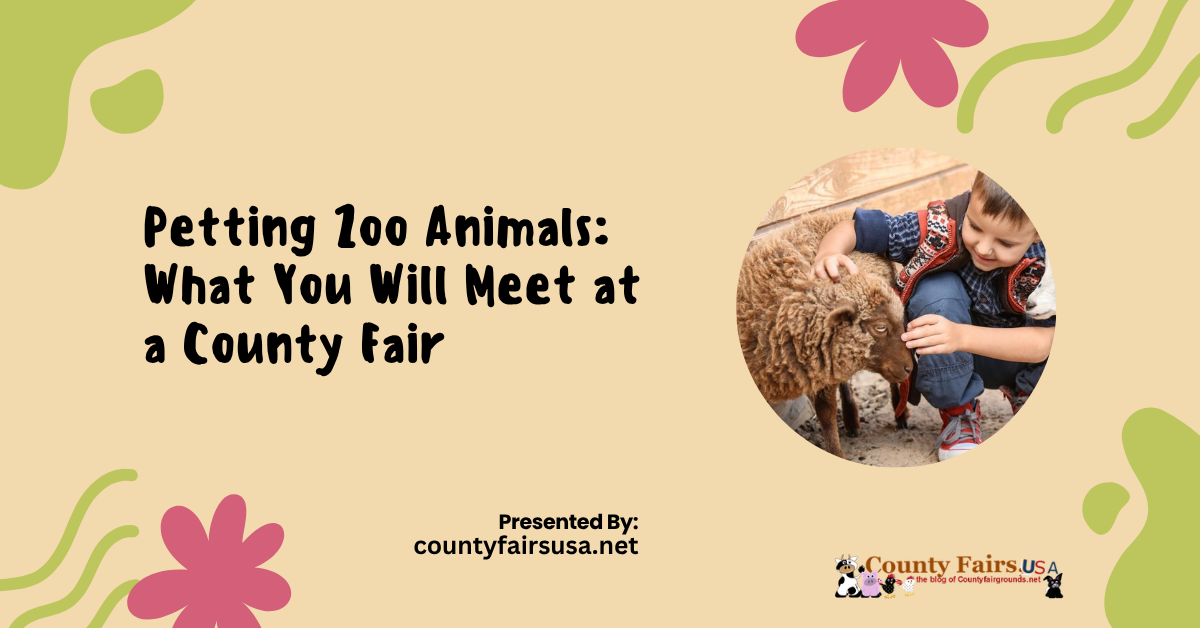
Petting Zoo Animals: What You Will Meet at a County Fair

For many families, the petting zoo is the first stop at the fair. Kids get to feed a hungry goat, touch soft wool, and see farm animals up close, often for the very first time. It is one of the simplest and happiest parts of fair day. If you are planning a trip with little ones, our county fair with kids planning guide helps you build the whole day around their age. This guide covers the petting zoo animals you are most likely to see, what each one is like to meet, how feeding works, and the safety steps every family should follow. What Is a Petting Zoo at a County Fair? A petting zoo is a fenced area where visitors can walk in, touch, and sometimes feed gentle animals. At a county fair, it is often run by a local farm, a traveling animal business, or the fair itself. Some petting zoos are small pens with a few goats and rabbits. Others are large tents with dozens of animals, staff on hand, and food cups for sale. Petting zoos are different from the livestock barns. The barns hold animals that are being shown and judged, usually by 4-H and FFA members. You can look and ask questions there, but you usually should not touch without permission. Petting zoo animals are chosen because they are calm and used to people. Learn more about the barn side of the fair in our post on why livestock shows matter at county fairs. Common Petting Zoo Animals You Will See Most county fair petting zoos stick to friendly farm animals. Here is a quick look at the usual crowd. Animal What They Are Like Can You Feed Them? Goats Curious, bold, and always hungry Yes, with pellets from staff Sheep and lambs Gentle and a little shy Yes, from a flat hand Rabbits Soft, quiet, easy to startle Usually no, petting only Chickens and ducks Busy and noisy Sometimes, with grain Piglets Playful and fast Rarely Calves Big eyes, calm, and gentle Sometimes, with a bottle Alpacas and llamas Calm, fluffy, and watchful Yes, with pellets Miniature horses and donkeys Friendly and patient Ask staff first Tortoises Slow and steady No, look and gently touch Goats Goats are the stars of almost every petting zoo. Pygmy goats and Nigerian Dwarf goats are the most common because they are small and friendly. Goats will happily climb, nibble on clothing, and follow anyone holding a feed cup. Hold cups low and keep [...]

By |2026-10-13T09:12:40+00:00October 1st, 2026|Animals, Children, County Fair, Goats|Comments Off on Petting Zoo Animals: What You Will Meet at a County Fair

Dairy Goats are wonderful things

A couple of Cute Kids JoJo Milano has have 8 years experience with raising, breeding, owning dairy goats. I'm also the, Vice chair of the South Florida Fair dairy goat show. Originally I got my first diary goat as a companion for my 28 year old horse.... and it sort of snowballed from there. Additional Info on Goats you might enjoy Heritage Breeds of Goats for Milk and Meat - Meat goats are fuller boned than the dairy breeds, where dairy goats have flat bone types ... Storey's Guide to Raising Dairy Goats: Breeds, Care, Dairying ... Most Beautiful Goats Competition - Udderly unbelievable but true, goats were on the catwalk for the Most Beautiful Goat at the Mazayen al-Maaz competition yesterday in Riyadh, capitol of Saudi Arabia. A Damascene goat -- or Maaz Al Shami -- named Qahr was the beauty ...

By |2016-10-23T11:34:45+00:00June 23rd, 2010|Animals, Florida, Goats|1 Comment

More about Goats and Sheep

Goats and Sheep is one of the smallest domesticated ruminants that have served the mankind former and longer than the cattle and sheep county fair. It is controlled for the production of milk, meat, wool and may other products, particularly in arid, semitropical or mountainous countries. In temperate zones, goats are kept frequently rather as additional animals by petite holders, while commercially cows or buffaloes are especially kept for milk, cheese and other meat products, and sheep for wool and meat production. More About Goats and Sheep Goats are fun to have as pets Nonetheless, there are more than 465 million goats worldwide currently producing more than Goats and Sheep 4.6 million tons of milk and 1.3 million tons of meat as well mohair, cashmere, leather and also dung; and more people drink milk and milk products from goats all-inclusive than from any other animal. Goats could love on bushes, trees, desert scrub and other aromatic herbs when sheep and cattle would starve to death. Goat herders frequently have deserted a balanced numerical stability among goat numbers and sparse vegetation. Over-grazing has smashed many tree and the woodland areas that were blamed then on goats other than man, and this has caused extensive ecological and political worries, erosion, desertification and as well ban on freely grazing goats in some of the world famous areas. Swiss Goats and Sheep breeds are the world's selected for milk production. Indian and Nubian resulting goat breeds are dual-purpose meat and for milk producers. Spanish and South African goats are top recognized for meat producing ability. The Turkish Angora, Asian Cashmere and the Russian Don goats are reserved for mohair and cashmere wool production. In addition, there are Pygmy goats from Western Africa of growing interest as laboratory and pet animals. Goat milk casein and goat milk fat are more simply digested than from any cow milk. Goat milk is appreciated for the elderly, ill, babies, children with cow milk allergies, patients with ulcers, and as well favored for raising waifs and strays foals or puppies. Fat globules in goat milk are slighter than in cow milk and stay dispersed longer Goats and Sheep. Breeds of goats differ from as little as 20 lb grown-up female body weight and 18 inches female shrivels for dwarf goats for purpose of meat production up to 250 lb and 43 inches shrivels height for Indian Jamnapari, Swiss Saanen, Alpine and Anglo Nubian for purpose of milk production. Some Jamnapari males might be [...]

By |2024-03-27T15:16:38+00:00May 10th, 2007|Goats, Sheep|0 Comments
Go to Top